
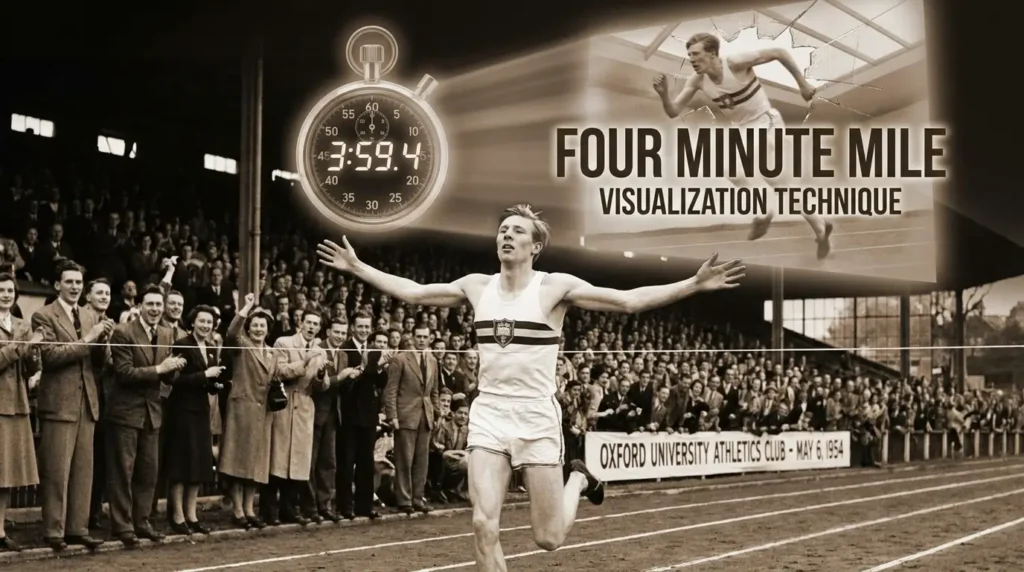
The roger bannister visualization technique remains history’s most powerful demonstration of defeating human performance ceilings by rewriting internal expectations. For decades, the running world was paralyzed by an absolute conviction: running a mile in under four minutes was physically impossible. Eminent medical experts warned that attempting such a feat would cause a runner’s heart to physically rupture under the strain. Yet, on May 6, 1954, a 25-year-old medical student named Roger Bannister stepped onto the Oxford University track at Iffley Road and shattered this deeply entrenched psychological wall. He did not achieve this through radical changes in human anatomy, but by systematically changing his internal vision of what was possible, creating a ripple effect that changed sports psychology forever.
Deconstructing the 1950s Psychological Barrier
To understand why this breakthrough required such intense mental preparation, one must examine the sheer weight of the cultural status quo at the time. Up until that fateful evening in May, the world record for the mile stood firmly at four minutes 1.4 seconds. This thin margin of less than two seconds served as an immovable brick wall for athletes globally.
The prevailing belief was that the physical limits of the human body in sports had been reached. The running community, track coaches, and sports journalists had collectively bought into a narrative of limitation. Because runners believed their hearts and lungs would literally give out, their central nervous systems naturally down-regulated their physical output whenever they drew close to the threshold. Bannister realized that before he could ever break the physical tape, he had to completely dismantle this collective delusion within his own mind.
The Science of the Roger Bannister Visualization Technique
Bannister’s unique advantage lay in his academic background. As a 25-year-old medical student, he looked at athletic performance through the lens of neurology and physiology rather than traditional, rigid coaching dogmas. He understood that the human body is governed by the brain, and the brain cannot always distinguish between a deeply embedded, high-fidelity mental rehearsal and a real-world physical event.
The core of the roger bannister visualization technique involved running the perfect race in his mind hundreds of times before ever setting foot on the track. He conditioned his nervous system to accept the intense distress of a sub-four-minute pace as normal rather than fatal. Squeezing his training sessions into short lunch breaks, his highly efficient roger bannister training method summary focused on high-intensity interval training paired with intense cognitive framing. He visualized his stride staying long, fluid, and relaxed, consciously overriding the panic signals his body would inevitably send during the final stretch.
Tactical Precision: The 1954 Race Blueprint
When the day of the meeting between the three A’s (Amateur Athletic Association) and Oxford University arrived, Bannister paired his psychological conditioning with flawless tactical execution. He knew that breaking an “impossible” record required absolute mathematical certainty, which is why he coordinated with two trusted colleagues who acted as his strategic pacemakers.
The team engineered a precise sequence of running split times for a 4 minute mile to keep Bannister perfectly on track without forcing him to waste mental energy calculating his position during the run.
| Split Milestone | Active Pacemaker | Split Target | Cumulative Time |
| First Quarter Mile | Chris Brasher | 57.4 seconds | 57.4 seconds |
| Half Mile Mark | Chris Brasher | 60.8 seconds | 1 minute 58.2 seconds |
| Three-Quarter Mile | Chris Chattaway | 62.3 seconds | 3 minutes 0.5 seconds |
| The Final Finish | Roger Bannister | 58.9 seconds | 3 minutes 59.4 seconds |
Teamwork and Environmental Hurdles at Iffley Road
The execution of this historic run provides a definitive look at the true role of a pacemaker in running track history. Chris Brasher took the initial lead, cutting through the air resistance and setting a blistering, steady rhythm for the first two laps. As they crossed the half-mile mark, the gallant Brasher, having achieved his selfless pacemaking task, dropped behind, allowing Chris Chattaway to spurt ahead.
This seamless transition during the period of chris brasher and chris chattaway pacemaking allowed Bannister to draft comfortably, saving critical physical reserves.
Beyond the competition, the elements themselves were hostile. The event took place on a wet, uneven cinder track, compromised by a heavy crosswind. Bannister initially considered calling off the attempt due to the weather. However, noticing a brief, slight lull in the wind right before the start, he made a conscious decision that there comes a moment when you just have to try. His mental visualization had already accounted for discomfort, enabling him to adapt instantly to overcoming bad weather conditions in running.
The Final Furlong and the Global Domino Effect
With 250 yards left to go, Chattaway stepped aside, and Bannister unleashed his final physical effort against the seconds that had barred humanity for generations. Watchers witnessed his giant stride take him to the front as he plunged into a lung-bursting furlong toward the finishing post. When the tape broke at exactly 3 minutes 59.4 seconds, Bannister stumbled blindly into the arms of his coach, completely exhausted but fundamentally victorious. Only a small crowd of less than 3,000 people, mostly undergraduates, were there to witness it.
The most profound validation of the roger bannister visualization technique happened in the days and months following the race. Once Bannister proved the barrier was a phantom, the collective mental shifts after running milestones are broken altered the sport forever. Just 46 days later, Australian runner John Landy ran a 3:57.9. Within a year, three more runners broke the barrier in a single race. To date, over 1,600 athletes have accomplished what was once deemed biologically lethal, proving that Bannister’s mental blueprint had permanently unlocked the floodgates of human potential.
Frequently Asked Questions
1. What exactly is the Roger Bannister visualization technique?
It is a method of high-fidelity mental rehearsal where an athlete repeatedly visualizes succeeding at a specific goal, conditioning the nervous system to accept a high-stress performance threshold as achievable before experiencing it physically.
2. How did Roger Bannister use his medical background to break the record?
As a medical student, he dismissed the unscientific myth that the human heart would fail at a sub-four pace, choosing instead to analyze human mechanics and neural fatigue from a clinical standpoint.
3. What were the exact lap times for the first sub-four-minute mile?
The laps were clocked at 57.4 seconds, 60.8 seconds, 62.3 seconds, and a final closing lap of 58.9 seconds to finish at 3:59.4.
4. Who were the pacemakers that helped Roger Bannister?
His training partners and colleagues Chris Brasher and Chris Chattaway provided the essential strategic pacing for the first three quarters of the race.
5. Where did the historic four-minute mile race take place?
The race was held on the Oxford University track located at Iffley Road during a meeting against the Amateur Athletic Association.
6. Why was the three-quarter mile time of 3 minutes 0.5 seconds so critical?
It meant Bannister had to run his final lap faster than his middle two laps, demanding an extraordinary final kick of 58.9 seconds to secure the record.
7. How many people were in the crowd to watch the record break?
A sparse crowd of fewer than 3,000 spectators, primarily Oxford undergraduates, witnessed the historic event live.
8. What track surface did Roger Bannister run on in 1954?
He ran on a traditional, wet cinder track, which was significantly slower and more uneven than modern synthetic running surfaces.
9. How fast must someone run a furlong to hit a four-minute mile pace?
An athlete must average roughly 29.9 seconds per furlong (220 yards) to maintain a steady sub-four-minute mile pace.
10. What is the “Bannister Effect” in modern sports psychology?
It is the phenomenon where a long-standing physical milestone is rapidly achieved by multiple individuals immediately after a single person proves it is possible.
11. Did Roger Bannister train with high mileage?
No, his training summary reveals he focused on precise, high-intensity interval workouts during his short daily lunch breaks from medical school.
12. How did bad weather affect the 1954 race?
Strong winds threatened to ruin the attempt, but Bannister identified a brief lull just before the starting gun and decided to take the risk.
13. What were the names of the two sports associations competing?
The competition was held between Oxford University and the Three A’s (Amateur Athletic Association).
14. What happened to the world record 46 days after Bannister broke it?
Australian rival John Landy shattered Bannister’s new record by running a mile in 3 minutes 57.9 seconds.
15. How did Bannister feel immediately after crossing the finish line?
He was completely exhausted and temporarily blinded by the effort, stumbling directly into his coach’s arms before recovering to thank the track groundsman.
16. Why did doctors believe the four-minute mile was impossible?
They believed human bone structure, wind resistance, and heart-lung capacity created an absolute physiological ceiling that could not be bypassed.
17. How can modern athletes apply this visualization technique?
By pairing rigorous physical practice with detailed mental run-throughs, visualizing sensory inputs, split times, and successfully pushing through performance plateaus.
18. What was the exact world record time before Bannister broke it?
The world record stood at 4 minutes 1.4 seconds, a benchmark that had remained unbeaten for nine years.
19. Did Bannister run the final lap entirely on his own?
Yes, after Chattaway finished his pacemaking duties at the three-quarter mark, Bannister ran the final 440 yards completely solo against the clock.
20. How many athletes have broken the four-minute mile today?
Over 1,600 runners have officially broken the barrier, confirming that the initial limitation was largely a psychological boundary.
Conclusion: Unlocking Your Personal Milestones
Roger Bannister’s historic achievement proved that the barriers holding us back are frequently constructed within our own minds. By combining tactical teamwork, disciplined physical preparation, and the roger bannister visualization technique, he fundamentally rewrote the boundaries of human potential. If you are currently facing an elite milestone or an seemingly immovable wall in your own athletic journey, look closely at your current mental framework. Focus on breaking your goals down into calculated intervals, surround yourself with an aligned team, and condition your mind to embrace the challenge long before you cross the starting line.

Pingback: Four Minute Mile Roger Bannister PDF: The Story, Science & Mindset That Changed Human History - primusiq.com