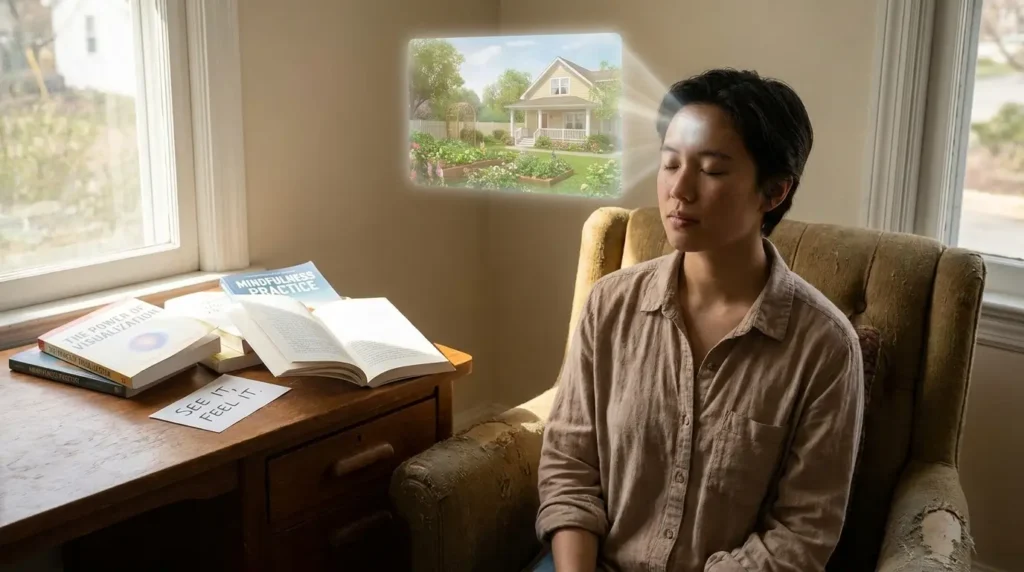
Introduction to the Mind Theater Visualization Method
The mind theater visualization method is one of the most powerful, yet fundamentally misunderstood, tools in modern personal development, hypnosis, and manifestation. Most people approach mental imagery by sitting back like a passive audience member, expecting an internal movie screen to magically change their lives. But true cognitive rewiring doesn’t happen from the theater seats. To change your deep reality, you have to break down the screen, fire the imaginary spectator, and step directly into the scene.
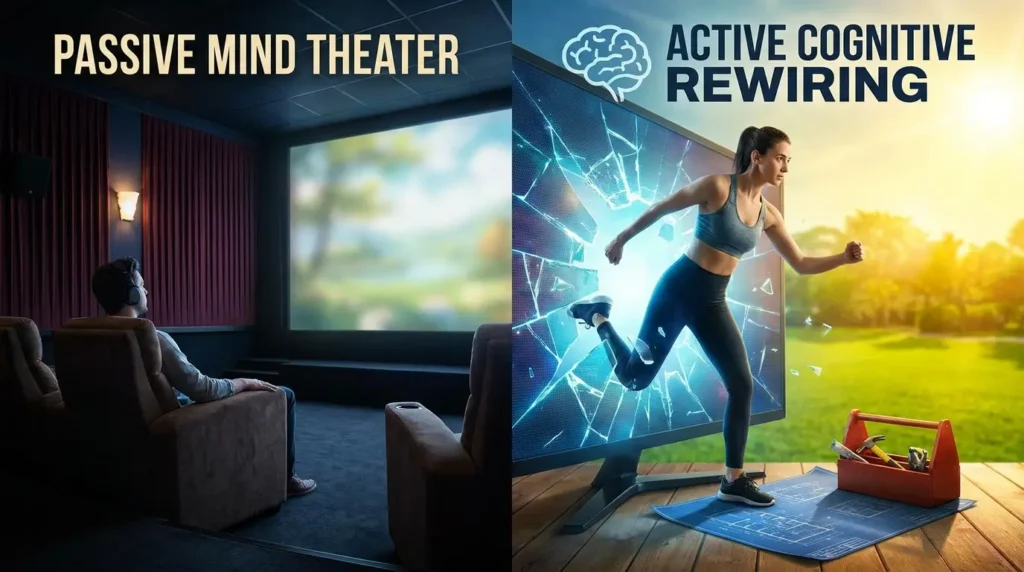
When you look for a guided visualization for wants, the goal is to bridge the massive gap between abstract wishing and concrete, subconscious programming. By shifting your perspective from a detached viewer to an active, physical participant, you alter the way your brain processes goals, moving from a state of passive hope to direct, nervous system level alignment.
Deconstructing the Spectator Illusion: First Person vs Mind Theater
When evaluating first person vs mind theater setups in storytelling and mental conditioning, many people fall into an instinctive psychological trap. They treat their consciousness like a dark cinema, where sensory information is projected onto a clean, internal movie screen. This intuitive model—popularly critiqued by philosophers as the Cartesian Theater—suggests that our eyes act as cameras, sending a live feed to an inner spectator sitting inside our brains.
However, modern cognitive science reveals that this spectator model is a logical illusion. If there is a screen inside the mind, you logically require an inner “little man” (a homunculus) to watch it, which creates an infinite loop of viewers inside viewers. The mind’s eye does not possess a literal projection screen with qualitative properties matching a real room. Instead, consciousness is a decentralized, simultaneous calculation of data.
When you practice mental conditioning through a first-person perspective, treating your mind like a passive theater creates a cold, detached emotional buffer. You stand back and report on your desires as an audience member rather than living through them. To capture true immersion and trigger genuine subconscious change, you must completely dismantle this inner screen.
The Illusionist View of Consciousness and Mind Engineering
To build genuine internal immersion, it helps to look at what philosophers call the illusionist view of consciousness. This concept suggests that our subjective experience of a unified, central theater is simply the brain misrepresenting its own complex data processing.
Individuals who do not understand this mistake end up trapping their minds inside the homunculus fallacy in first person narrative. They run internal monologues that describe the process of observing rather than the raw observation itself.
For example, someone trapped in the mind theater trap might tell themselves, “I noticed the smell of success and felt my heart start to pound.” This tells the brain that a spectator is watching a heart pound on a screen. By understanding that the inner screen is an illusion, you can skip the mental projector entirely and focus directly on visceral reactions: “Adrenaline stings my chest. My ribs rattle with every heartbeat as I step onto the stage.”
Shifting Perspectives: How Point of View Alters Subconscious Power
Who is directing your internal script, and from what perspective, determines the structural success of your mental conditioning. Manifestation and identity shifts change completely when told from a different point of view. Take a look at how shifting perspectives alters the balance between first person vs mind theater:
| Narrative Point of View | Structural Characteristics | Impact on Internal Closeness |
| First Person (“I”) | Restricted entirely by your immediate, live sensory knowledge. | Creates maximum closeness, but highly vulnerable to the mind theater trap. |
| Third Person Limited | Sticks close to an outside view of yourself, keeping the narrator separate. | Balances individual focus with a healthy, natural psychic distance. |
| Third Person Omniscient | Able to flit between global perspectives and systemic information. | Offers a wide perspective, perfect for establishing systemic or structural distance. |
Constraints in internal scripting are not obstacles; they are tools designed to focus your mind or highlight specific emotional elements. For instance, a third-person view is necessarily a bit removed from the self. While this might seem restrictive, that exact emotional distance is highly effective for stories or memories where a feeling of isolation or grand scale is important. A third person perspective can be limited, meaning it sticks close to one character’s thoughts and feelings, or it can be omniscient, able to flit between multiple viewpoints and give a broader view of the environment.
Breaking the Rules of Perspective to Overcome Deep-Seated Blocks
Operating entirely in a first-person mental state naturally creates immediate closeness between your conscious intent and your subconscious engine. However, it is fundamentally restricted by your immediate knowledge. You can use these exact constraints to build incredible focus, discovering new insights alongside your evolving self.
Furthermore, an internal narrator does not have to represent their experience faithfully; they can be delusional, dishonest, or blinded by their environment.
- The Unreliable Internal Narrator: In Kazuo Ishiguro’s masterwork The Remains of the Day, an aging British butler named Stevens recounts his many years of service in 1956. However, he consistently fails to acknowledge the glaring moral flaws of the aristocratic master he serves.
- The Structural Impact: The subtle narrative cracks in unreliable narrators eventually draw the attention to the under-acknowledged failings of the entire class system and culture he inhabits.
When engineering change, experimenting with fresh variations on point of view shatters traditional psychological expectations. Consider Justin Torres’s novel We the Animals, which begins with a rare plural first-person narrator:
“We were six snatching hands, six stomping feet; we were brothers, boys, three little kings locked in a feud for more.”
Partway through the story, the point of view dynamically shifts from the plural we to the singular I, as the boys come of age and one brother feels alienated from the others. This sudden shift perfectly mirrors the protagonist’s coming-of-age, highlighting his growing sense of alienation as he separates from the collective identity of his brothers. In your own mind, shifting from a collective family identity (“we”) to an independent self (“I”) can unlock deep personal breakthroughs.
Escaping the Theater Trap: Scripting Your Visceral Reality
To successfully execute the mind theater visualization method, look at how a simple fairy tale like Rapunzel changes when you break down the cinema screen and step into a character’s messy, tangible reality.
In a standard third-person perspective, the narrator stands completely outside the story: “Rapunzel, Rapunzel,” the Prince called, “let down your hair.” Rapunzel unbraided her hair and slung it out the window. The prince climbed her tresses into the tower.
If we rewrite this into an internal first-person perspective but stay trapped in the passive mind theater, it sounds like an informational logbook. But if we ground the mind completely by capturing raw physical sensations in first person point of view, the screen shatters. Say a first person narrator was climbing the tower:
“The tail end of Rapunzel’s locks plopped down at my feet. I grabbed on and began to climb… ugh! I couldn’t untangle myself. Strands came off all over me, sticking to my sweat.”
Now, consider the scene flipped to Rapunzel’s internal perspective, breaking away from the passive theater screen of her thoughts to show active, grounded frustration:
“I hope he appreciates how long it takes to unbraid 25 feet of hair, I thought. OUCH! I’ll be honest; I thought my scalp would stretch off of my skull. “Can you climb any faster?” I yelled.”
By forcing your visualization to process these gritty, highly specific details, you bypass the analytical mind and convince your nervous system that the neuro-linguistic experience is happening right now.
The Unconventional Mechanics of Second Person Mental Shifts
The second person perspective (“you”) is a much less common choice in traditional fiction, but it offers a unique look at internal narrative distance. It requires you to make your mind actively suspend disbelief to become another “you”:
“He calls your name. He wants you to let your hair down. You just finished braiding it, but hey—you don’t get a lot of visitors.”
Placing your attention directly into a tight, alternate vantage point builds immediate urgency and suspense. Interestingly, authors and psychological strategists also use the second person for the exact opposite reason: to create deep emotional distance.
In these unique cases, second-person narrators refer to themselves as “you” rather than “I.” This acts as a psychological defense mechanism, allowing an individual to distance the narrator from their own story, rather than bring the reader closer to the text. It functions as a powerful tool for navigating trauma, dissociation, or intense self-alienation. When rewriting your internal limitations, addressing yourself as “you” can give you the objective distance needed to clear old subconscious defense mechanisms.
Frequently Asked Questions: Mind Engineering & Narrative Mechanics
1. What is the core difference between the mind theater visualization method and standard visualization?
The main difference lies in how thoughts and images are delivered. Standard methods incorrectly handle internal consciousness like a literal projection screen where you sit back and observe your goals. The mind theater visualization method breaks this screen by directly merging you with raw, immediate actions, thoughts, and physical sensations.
2. Why does the theater of the mind metaphor fail in self-hypnosis?
It fails because it introduces an artificial buffer known as the homunculus fallacy. When your mind spends too much time explaining how it noticed, felt, or saw things, it stops experiencing the scene and starts acting like a spectator watching a movie of its life, which destroys your internal narrative pacing and emotional resonance.
3. What is Daniel Dennett’s Cartesian Theater?
Coined by philosopher Daniel Dennett, the Cartesian Theater is a critique of the traditional view of consciousness, which assumes there is a single, centralized place in the brain where everything comes together to be displayed to an internal viewer.
4. How do you identify the homunculus fallacy in your own visualization sessions?
Look for repetitive internal filtering phrases such as “I see myself,” “I notice myself,” “I feel like I am,” or “I realize.” These mental words imply that a mini-viewer is sitting inside your head, processing data before passing it to your subconscious.
5. What are narrative cracks in unreliable narrators?
Narrative cracks are the subtle contradictions, omissions, or emotional blind spots in a story that reveal the narrator is lying to themselves or the reader. A brilliant example is found in literary fiction works like The Remains of the Day.
6. Why would a script or meditation use the second person perspective?
Writers and hypnotherapists use the second person (“you”) to create immediate urgency, build intense suspense, or intentionally showcase an internal narrator who is psychologically distanced from their own traumatic experiences.
7. What is psychic distance in creative mind engineering?
Psychic distance refers to the scale of emotional and psychological closeness between the observer and the inner thoughts. It ranges from a completely detached, omniscient objective view to an immediate, unfiltered stream of consciousness.
8. How does third person limited differ from third person omniscient in mental practice?
Third person limited stays locked inside the immediate knowledge, thoughts, and feelings of a single viewpoint. Third person omniscient is an all-knowing perspective that can flit seamlessly between multiple minds and angles.
9. Can psychological constraints actually improve a visualization’s narrative arc?
Yes, narrative constraints focus your mental energy. Limiting what you consciously track creates natural tension, forces creative problem-solving, and keeps your subconscious mind actively working alongside your core intentions.
10. What is the illusionist view of consciousness?
It is a philosophical framework stating that while our subjective minds feel like they have a unified, magical screen of experiences, this qualitative property is an illusion. The brain simply processes massive amounts of parallel calculations.
11. How do you write or visualize physical sensations in first person point of view naturally?
Focus on visceral, immediate reactions instead of internal observations. Instead of visualizing that you feel cold, focus on your shivering muscles, your numb fingertips, or the crisp frost catching on your eyelashes.
12. What does it mean to have a plural first-person internal narrator?
A plural first-person narrator uses the perspective of “we” rather than “I.” It represents a collective voice, familial programming, community, or shared group identity, as seen in novels like We the Animals.
13. Why do internal mind shifts move from plural “we” to singular “I”?
This shift is frequently used to symbolize an individual coming of age, breaking away from limiting family dynamics, or experiencing personal freedom, alienation, and distinct individuality.
14. Is the mind’s eye a literal projection system?
No. Cognitive science demonstrates that processing sensory and visual data does not involve an actual inner screen or a second set of eyes looking at a projection inside the skull.
15. How do new virtual and augmented reality technologies affect human storytelling?
VR and AR technologies expand storytelling by placing people at a specific physical vantage point in virtual space. It transforms the audience from passive readers into active physical participants who drive the narrative perspective.
16. What is head-hopping and how do you avoid it in scriptwriting?
Head-hopping occurs when a creator accidentally switches character perspectives within a single scene without a clear transition. You can avoid it by maintaining a strict third person limited or establishing a deliberate omniscient voice.
17. How does a detached narrator benefit a historical fiction novel?
A detached narrator establishes an objective, bird’s-eye view of large-scale historical events, allowing the reader to analyze the broader cultural and class systems at play without being overwhelmed by a single character’s bias.
18. What are filtering verbs in creative writing and manifestation scripts?
Filtering verbs are words that place a buffer between the user and the action. Examples include “he heard,” “she watched,” or “I perceived.” Removing them creates an immediate, highly immersive experience.
19. How do you create suspense using a limited point of view?
By restricting what your narrator knows, you align the audience’s knowledge perfectly with the character’s journey. Suspense builds naturally because threats or plot twists hit both the character and the reader simultaneously.
20. Can second person perspective refer to the narrator themselves in psychological fiction?
Yes. In psychological fiction, a narrator using “you” is often talking to themselves, splitting their identity to cope with stress, guilt, or deep emotional disconnect.
Conclusion: Stepping Beyond the Internal Movie Screen
Mastering the mechanics of the mind theater visualization method is essential for anyone aiming to write deeply resonant content or unlock profound subconscious change. By recognizing that the human mind is not a passive cinema screen, you can stop operating as a spectator of your thoughts and start acting as the physical author of your reality. Dismantling the internal cinema allows you to leverage narrative constraints, maximize psychic closeness, and craft internal scripts that resonate on a visceral human level.
Take a close look at your active mental scripts and visualization habits. Are you sitting back in theater seats watching your desires unfold like a movie, or are you getting your hands dirty in the scene? Step down from the audience, strip away the passive filtering verbs, focus heavily on raw sensory data, and shatter that inner projection screen once and for all.