
Moving Beyond Traditional Mental Imagery
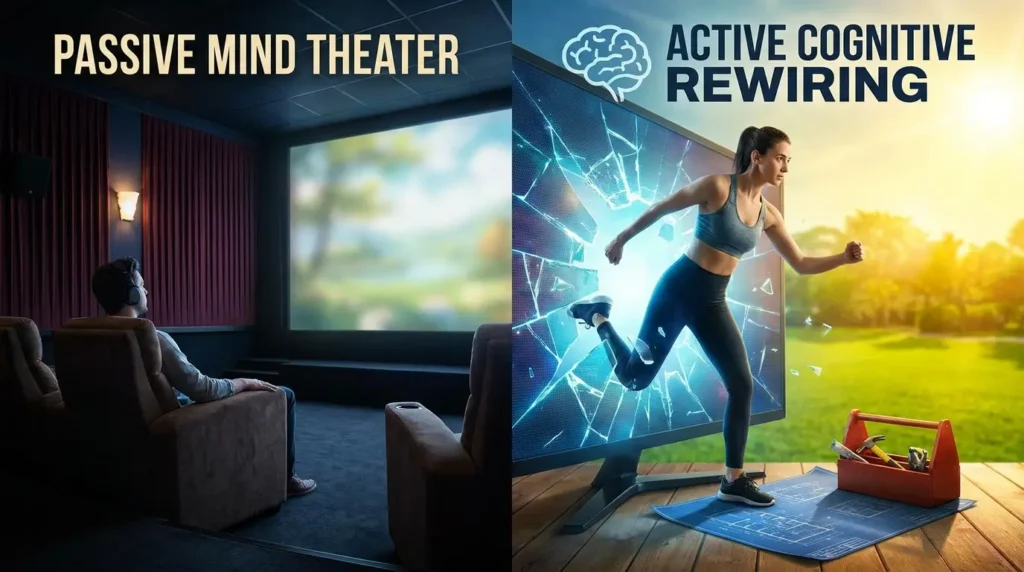
When we talk about manifestation and deep mindfulness, the concept of visualization inevitably takes center stage. For decades, mainstream teachers and self-help gurus have instructed us that to change our reality, we must master the art of mental imagery. We automatically assume that this means to close our eyes, activate an internal television screen, and see the final result playing out like a movie. We are told to see ourselves living in the end with absolute clarity.
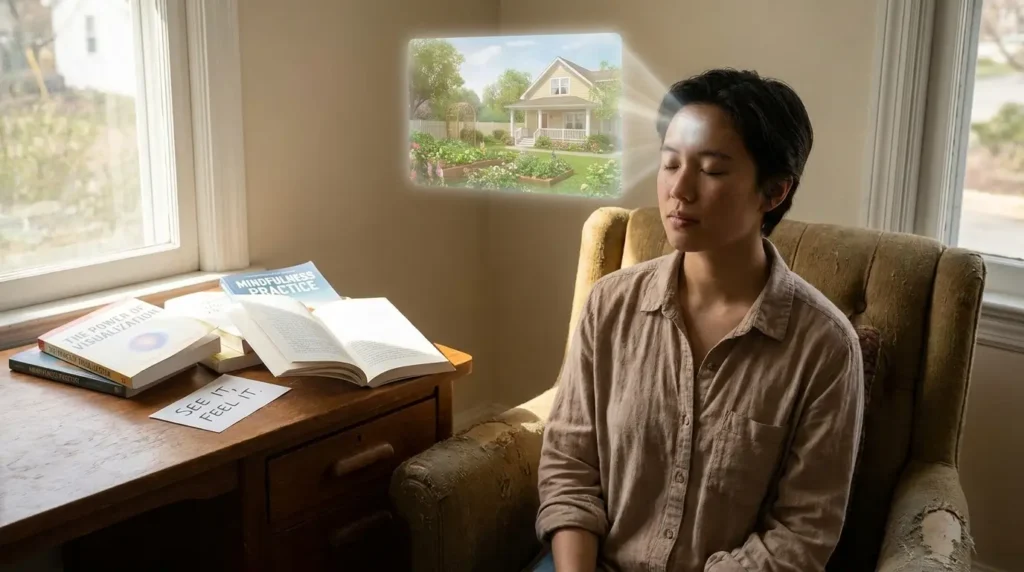
While forming mental pictures is a wonderful tool for some, it often creates an unintended barrier for many others. If you are someone who constantly struggles with seeing the goal, or if you find it incredibly difficult to focus visually on an image or a scene in your mind for any sustained amount of time, it is remarkably easy to feel left behind. You might be quick to assume that this entire methodology simply is not applicable to you or your cognitive style.
However, the truth is not that visualization doesn’t work for your brain; rather, it is that we have collectively misunderstood the true underlying mechanism of the practice. The real purpose of visualization is not optical sight—it is complete, deep-seated immersion.
By shifting your approach toward the sensory immersion visualization technique, you stop fighting your mind’s eye and begin engaging your entire nervous system. This approach transforms meditation from a frustrating visual exercise into a grounded, multi-sensory experience where your preferred reality feels entirely certain.
Decoding the Science of Immersion: Why Your 3D Reality Feels Real
To understand why the sensory immersion visualization technique is so highly effective, we must first analyze why our daily physical environment feels so concrete. The reason why our physical 3D reality feels so real to us is because we are observing and interacting with it with more than just our sense of sight. Traditional meditation guides often over-index on mental imagery, causing many practitioners to believe they are failing if they cannot see a crisp internal picture. In true cognitive processing, sight is merely one piece of a much larger puzzle.
Our brains establish certainty through a continuous loop of multi-sensory feedback. You don’t just look at the world; we can hear this reality, we can feel this reality, and this reality has a distinct smell and a taste. This complete sensory web is what builds your unshakeable conviction that what you are experiencing is real. When you shift your mindfulness practice toward a sensory immersion visualization technique, you tap directly into this hardwired neural mechanism.
The Baseline Sensory Test: Measuring Your Present Environment
Before attempting to build an imagined state, you can easily test your brain’s reliance on non-visual data by examining your immediate surroundings. Consider the phone or the device that you are currently using to watch this video or read this article. If you pause for a brief second, can you not feel the weight of it in your palm, and the specific texture of its outer casing? Can you not hear my voice clearly as you process these words internally?
Depending on exactly where you are currently seated, laying, or standing, you can feel the precise environment around you right now. Your skin registers the ambient temperature, your body feels the pressure of the chair or bed, and your ears catch background frequencies.
Now, close your eyes for a brief moment. Even with your eyelids firmly shut, can you still not feel the physical device you’re currently using? Can you still hear my voice echoing in your mind? Depending on where you’re seated, laying, or standing, can you still not feel the environment around you?
Wouldn’t it be highly accurate to say that you are currently experiencing this reality even though you cannot see it? This simple realization changes everything. All visualization really is is the observation and the experience of another reality, and we experience reality through our senses only, but not only through the sense of sight. Therefore, if you are struggling with a lack of mental clarity, it simply means you’ve become too dependent on what you can see.
Applying the Neville Goddard Sensory Feeling Technique
If my previous breakdown failed to fully clarify this mental shift, perhaps an actual audio recording excerpt of Neville Goddard himself could shed light on the mechanics of the sensory immersion visualization technique. Goddard revolutionized the concept of mental formatting by proving that true prayer and alignment are, as far as he was concerned, nothing more than the subjective appropriation of the objective hope. He believed that this is the absolute way to true success.
But how exactly do you appropriate a state subjectively when you cannot see it clearly in your mind? To answer this, Goddard provided a brilliantly simple framework that shifts your focus from optical sight to tactile awareness. He asked his audience to suppose that at this very moment they wanted a ball—specifically, an ordinary baseball—but there isn’t a baseball physically present in the room.
Instead of trying to force a clear visual picture of the ball, Goddard’s core instruction was to actually assume that you are holding that baseball in your hand until you can physically feel its weight and structure. Many people mistakenly think they cannot feel something that isn’t physically there, but Goddard challenged his students to simply try it before dismissing its power.
Mastering Tactile Distinctions for Deep Sensory Immersion Visualization
To prove that you have successfully held and captured an object in your mind’s eye, you must test your ability to recognize the subtle differences between distinct textures. This baseline test forms the core foundation of a successful sensory immersion visualization technique. Try to feel what it would be like if you held a baseball right now, and notice its unique weight and stitched seams. Then, immediately shift your awareness to see what the difference feels like if you switch to a fuzzy tennis ball. Can you track the difference?
Next, transition your thoughts to a hard, dimpled golf ball, and notice the immediate shift in size and density. Finally, imagine running your hand across a smooth, delicate piece of silk. Can you feel the difference?
Goddard pointed out that if you can easily distinguish between these many objects though they are entirely subjective, then those distinct realities must exist somewhere within your consciousness. If you can actually separate them in your mind’s eye and distinguish between these objects, you can begin to apply the same rule to any life goal.
Expanding Your Focus Beyond the Bounds of Sight
Once you learn to anchor your focus using your sense of touch, you can effortlessly begin to sink into, feel, and even smell your preferred states. For example, a rose has a highly specific aroma that doesn’t actually have the odor of any other flower in the world.
In a state of deep meditation, you can consciously detect the crisp scent of a rose, and then instantly pivot your mind to detect a completely different scent profile, such as an Easter lily. By training your mind to isolate these delicate, non-visual details, you unlock the true power of the sensory immersion visualization technique, allowing you to build an unshakeable sense of realism without ever needing a clear mental picture.
Sinking Into Abundance: The Olfactory and Tactile Sensation of Money
When applying the sensory immersion visualization technique to major personal milestones or financial goals, the process follows the exact same sensory laws. People often fail to manifest financial abundance because they try to visualize an arbitrary, blurry number on a digital screen. However, your subconscious mind cannot easily establish certainty around flat pixels. To bypass this mental friction, you must follow the precise principles of multi-sensory formatting and engage your non-visual senses.
According to the historical archives of Neville Goddard, even money has a highly specific odor that is completely unlike any other scent in the world. Goddard noted that this scent profile is actually more fragrant to a miser than the most marvelous perfume in the world. A person who loves abundance can have a money bag placed near their face and instantly identify it because they intimately know and love that exact scent profile.
To integrate this concept into your mindfulness practice, you must learn to distinguish these textures in your mind’s eye. If you put a crisp twenty-dollar bill directly into your hand right now and compare it to a standard piece of blank writing paper, your fingertips can instantly tell the difference. There is a completely distinct weight, grain, and physical feel to authentic currency. This exact sensory distinction is a fundamental part of the inner man, serving as a pillar for creative visualization methods for manifestation. As the classic teachings remind us, all things are possible to the individual who is willing to try it before they condemn it.
Overcoming Frustration When You Can’t Visualize Success
If you are currently struggling to visualize your ultimate ideals—whether it is the exact money you want, a beautiful partner, your ideal gorgeous body, or a fabulous car—the solution is to immediately stop trying to force a visual picture. Instead, rely completely on your other senses beyond sight to experience these things as a current reality.
If you are focusing on calling in a meaningful relationship, utilize tactile visualization techniques to bring the experience to life. Close your eyes and mentally interact with the person of your dreams. Ask yourself:
- What do they physically feel like when you hold their hand?
- Can you touch different parts of them to establish absolute realism?
Yes, the raw data mechanics of this technique explicitly instruct you to do exactly that. Do that with absolute focus. If you are visualizing your ideal body, close your eyes and physically trace what it must feel like to touch your perfect tummy or your healthy, strong frame. Shifting your attention to these dense physical boundaries collapses the psychological distance between your current state and your preferred reality.
Engineering Auditory and Tactile Triggers for Ultimate Reality Immersion
To successfully integrate the sensory immersion visualization technique into your daily routine, you must learn to build highly complex, automated mental scripts. Moving past standard imagery means treating your mind like a high-definition recording studio where you carefully mix different layer details. If you have previously relied on simple visual flashes, shifting your focus to interactive audio patterns will completely revolutionize your mindfulness practice.
Consider the common example of visualizing a premium automobile. Instead of passively staring at a flat, blurry image of a luxury car in your mind’s eye, the raw data mechanics of this technique instruct you to break the scene down into distinct, hyper-realistic physical actions. Close your eyes and run through a targeted sequence of sensory steps:
- The Tactile Entry: Imagine walking up to the vehicle and wrapping your fingers around the door handle. What does the cold metal or smooth carbon fiber feel like against your palm? As you pull it open and slide into the driver’s seat, notice the dense texture of the leather steering wheel beneath your hands.
- The Olfactory Anchor: Take a deep breath and isolate the signature new car smell as it fills your lungs. This distinct leather and upholstery scent serves as an immediate neurological anchor for creative visualization methods for manifestation.
- The Auditory Confirmation: Pull the heavy door completely shut. Pay intense attention to the mechanical thud and the sharp sound of the locks clicking into place.
The Sound of Silence: Anchoring Focus in the Mind’s Eye
Once the door locks engage, an immediate shift occurs in your surrounding environment. Ask yourself: What exactly are you hearing now that you are securely inside? For a high-performance vehicle, the transition from the noisy external world to the cabin is defined by an abrupt, absolute quiet.
Isolate how silent the interior becomes. What is the specific sound of that silence that you hear inside your amazing new vehicle? Focus on the slight, pressurized acoustic stillness that fills the space. By anchoring your attention on this deep auditory boundary rather than trying to force a bright visual flash, you trigger a profound shift in your nervous system.
This specific practice helps beginners understand how to meditate when you can’t visualize standard images, because your brain cannot distinguish between a highly detailed, multi-sensory mental script and a physical 3D experience. Try this exact sequence the next time you practice, and come back to track the immediate difference in your results.
Integrating the Sensory Immersion Visualization Technique Into Daily Practice
To truly master the sensory immersion visualization technique, you must treat it as an experiential shift rather than a rigid visual chore. Moving beyond standard mental pictures requires you to fully commit to the specific sensory layers we have discussed. When you execute these mental scripts, you are completely reshaping your mindfulness practice by removing the psychological pressure to see images clearly.
The true power of this methodology lies in its immediate execution. The next time you begin your practice, intentionally put aside the desire to form a clear mental picture. Instead, fully immerse your focus in what you can feel, hear, touch, and smell. Run through your custom sensory scripts with deliberate, slow attention to detail. Once you complete your session, come back to your notebook or journal and document your progress. Track whether you noticed a profound difference in your emotional certainty and how anchored you felt to your goals throughout the process.
Frequently Asked Questions: Sensory Immersion and Multi-Sensory Meditation
1. What is the sensory immersion visualization technique?
The sensory immersion visualization technique is a mindfulness and manifestation method that focuses on engaging all five physical senses—especially touch, sound, and smell—rather than relying solely on clear mental images in your mind’s eye.
2. Can you visualize without seeing images?
Yes, absolutely. True visualization is about experiencing a state of deep emotional and physical immersion. You can build complete psychological certainty by focusing on textures, weights, sounds, and ambient fragrances instead of forcing optical clarity.
3. How do I practice visualization meditation if I have aphantasia?
If you experience aphantasia (the inability to form voluntary mental images), shift your entire focus to tactile boundaries, environmental temperatures, and internal sounds. This allows you to experience a robust sensory immersion visualization technique without needing any visual data.
4. Why do I struggle with focusing visually during meditation?
Most people struggle because the brain feels immense cognitive strain when forced to project flat, imaginary screens. Shifting to creative visualization methods for manifestation that utilize touch and sound bypasses this frustration naturally.
5. How does Neville Goddard define sensory feeling in manifestation?
Neville Goddard explained that true internal alignment is the subjective appropriation of the objective hope. He taught that assuming the exact physical feeling of an object or environment until it feels completely real is the true key to success.
6. What is an example of a tactile visualization exercise?
A classic exercise involves mentally holding a baseball, then switching to a fuzzy tennis ball, a heavy golf ball, and a smooth piece of silk. Learning to distinguish these textures without sight strengthens your multi-sensory baseline.
7. How do I use auditory cues during creative visualization?
To use auditory cues, isolate specific mechanical sounds tied to your goal. For instance, imagine the crisp, distinct thud of a luxury car door closing and the precise sound of the automatic locks clicking into place.
8. What does the “sound of silence” mean in meditation?
The sound of silence refers to the immediate, pressurized stillness you experience when you mentally isolate yourself from external distractions, such as sitting inside a perfectly sealed, quiet room or vehicle cabin.
9. How can I manifest financial abundance using my sense of smell?
Money has a highly specific, distinct odor. By mentally focusing on the unique, fragrant scent profile of crisp paper currency rather than looking at flat numbers, you build a deeper subconscious connection to abundance.
10. Can sensory immersion meditation help reduce daily anxiety?
Yes. Engaging your physical senses through tactile visualization techniques grounds your nervous system in the present moment. This breaks repetitive anxious thought loops and triggers a profound relaxation response.
11. How often should I practice multi-sensory visualization?
For optimal results, practice daily for 10 to 15 minutes. Consistency allows your subconscious mind to easily adopt your custom sensory scripts as a natural, familiar state of being.
12. Why does my mind wander when I try to meditate?
The mind typically wanders when it feels overwhelmed by abstract or vague concepts. Providing concrete details—like textures, weights, and smells—gives your brain a solid anchor to maintain deep focus.
13. How do I know if my visualization practice is actually working?
You will know it is working when the imagined state triggers a genuine, physical emotional response—such as a deep sense of relief, excitement, or profound peace—that lingers after you open your eyes.
14. Is sight the most important sense for successful manifestation?
No. Sight is merely one component of how we process our physical environment. Engaging a combination of hearing, touch, and smell actually creates a much higher level of neurological certainty.
15. How can I make my mental scripts feel more authentic?
Incorporate everyday physical actions into your scripts. Instead of just looking at an ideal environment, imagine walking through it, touching the furniture, feeling the air temperature, and hearing ambient background sounds.
16. What should I do if I can’t imagine smells or tastes clearly?
Always lean heavily into your dominant real-world sense first. If you are a naturally tactile person, build your entire session around textures and physical pressure, then let other senses layer in over time.
17. How do I visualize an ideal body without focusing on a mirror image?
Instead of forcing a visual reflection, close your eyes and focus on how that healthy body physically feels from the inside. Trace the feeling of a strong frame, a firm tummy, and a deep, uninhibited breathing pattern.
18. What is the biggest mistake beginners make in visualization meditation?
The biggest mistake is assuming that a lack of perfect visual clarity means the technique is not working. True visualization is about cultivating an internal experience of certainty, not seeing a perfect mental movie.
19. Can I combine visual imagery with sensory immersion?
Yes. If you can naturally form mental pictures, you should absolutely layer in touch, sound, and smell. Combining all five elements creates the ultimate high-definition framework for deep focus.
20. How do I ground myself after a deep sensory immersion session?
Slowly bring your awareness back to your immediate physical 3D environment. Feel the weight of the device in your hand, notice the chair supporting your body, take a deep breath, and gently open your eyes.
Conclusion: Unlocking Your True Inner Reality
The ultimate secret to mastering the sensory immersion visualization technique is recognizing that your mind experiences reality through a complete, multi-sensory web rather than through a single visual channel. When you move past the limitations of traditional mental imagery and intentionally activate your senses of touch, sound, and smell, you eliminate the cognitive strain that stops so many practitioners in their tracks. By practicing the art of distinguishing subtle textures and anchoring your focus in dense, realistic physical actions, you can effortlessly align with your goals and experience a profound transformation in your daily practice.
If you have spent months or years feeling frustrated because you struggle to form clear pictures in your mind’s eye, remember that your mind is fully capable of experiencing an entirely new level of certainty right now. Take these multi-sensory tools, experiment with your own custom scripts during your next quiet session, and allow your inner awareness to expand beyond the boundaries of sight.

Pingback: Sensory Immersion Mastery: 2026 Blueprint for Multi-Sensory UX and Experiential Retail Architecture - primusiq.com