
Brain rules for better learning can explain why some people study hard, put in long hours, and still don’t get the results they expect. You might feel mentally full but struggle to focus. Names slip away, and what you studied yesterday feels blurry today. Meanwhile, someone who seems to study less remembers more and stays calm under pressure.
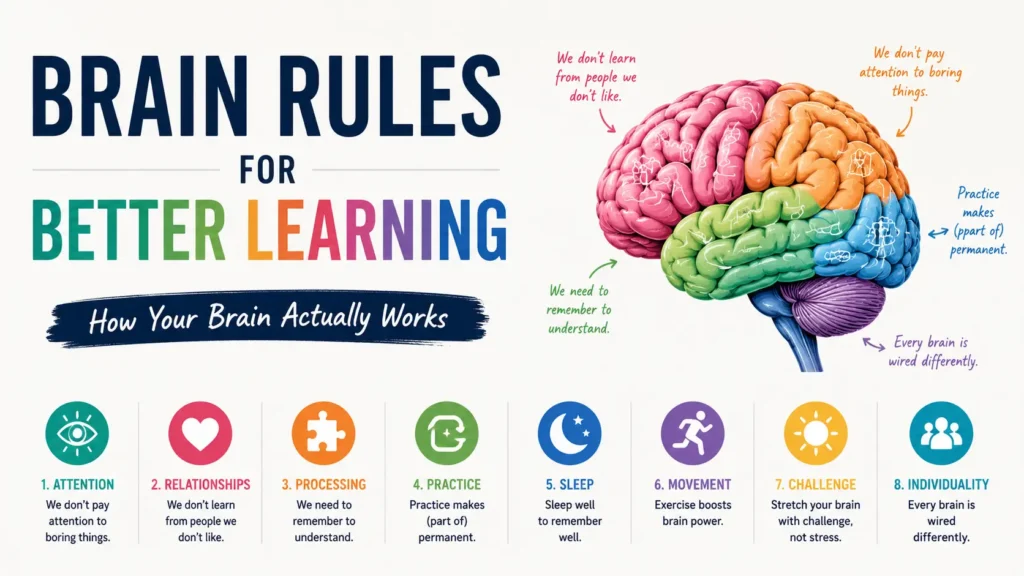
The truth is, this gap usually isn’t about intelligence or effort. It’s because most people were never taught the basic brain rules for better learning — how the brain actually functions, processes information, and performs at its best.
Why Understanding Your Brain Changes Everything
We spend years learning math, science, history, and other subjects in school, but almost no one teaches us how our own brain works. We push it hard, overload it with information, and then wonder why it feels tired, distracted, or forgetful.
Once you understand the real brain rules for better learning, studying and working stops feeling like a constant struggle. You begin to work with your brain instead of against it.
Why Most People Struggle With Learning
Brain rules for better learning matter because most of us were never taught how our brain actually works. We spent years in school learning subjects like math, science, and history, but no one explained the basic operating system of our own mind.
In today’s world, our brains are constantly bombarded with notifications, social media, endless information, and pressure. We expect ourselves to focus deeply, learn quickly, and make smart decisions, yet we often feel mentally exhausted, distracted, or unable to retain what we studied.
The problem isn’t that you’re not trying hard enough. The problem is that you’re trying to use your brain in ways it wasn’t designed for.
The Missing Piece in Modern Learning
Brain rules for better learning reveal that real improvement comes from understanding how the brain functions best. This is not another motivational talk. It is based on modern brain science that shows exactly why some people learn faster, remember more, and stay calm under pressure while others struggle despite working harder.
When you learn to work with your brain’s natural rules instead of against them, studying becomes easier, focus improves, and knowledge actually sticks.
Brain Rules for Better Learning: Why Movement Matters
Brain rules for better learning show us that physical movement is one of the most powerful ways to improve brain performance. Your brain was not designed to sit still for long hours. It evolved while humans were active — walking, running, and moving through their environment.
When you move your body, blood flow and oxygen to the brain increase. This leads to better focus, faster learning, and stronger memory. Even simple activities like a 20–30 minute walk can make a noticeable difference in how clearly you think and how well you retain information.
Brain Rules for Better Learning: The Power of Exercise
Many people believe they should sit and study harder to learn more. However, brain science tells a different story. Regular movement and light exercise are essential for optimal brain function.
Students who engage in physical activity before studying or taking tests often perform better. Movement helps release chemicals that improve mood, reduce mental fatigue, and support the brain’s ability to form new connections. If you feel mentally stuck or foggy, getting up and moving might be more effective than forcing yourself to keep reading.
Why Sitting Still Works Against Your Brain
Brain rules for better learning reveal that sitting for long periods works against how your brain naturally operates. When your body is inactive for too long, your mind becomes sluggish and less efficient.
This is why many people feel tired and unfocused after hours of desk work, even if they haven’t done anything physically demanding. Understanding this rule helps explain why active breaks and movement throughout the day often lead to better learning outcomes than pushing through long, motionless study sessions.
Brain Rules for Better Learning: The Power of Sleep
Brain rules for better learning show us that sleep is one of the most important factors for memory and performance. While you sleep, your brain doesn’t shut down — it works hard to process and organize everything you learned during the day.
It strengthens important memories, clears mental clutter, and prepares you for new information. People who get good sleep learn faster, remember more, and make better decisions. Cutting sleep to study longer actually works against you. You retain less information and feel mentally foggy the next day.
Brain Rules for Better Learning: Why Stress Is So Harmful
Chronic stress is one of the biggest enemies of effective learning. When you’re under constant pressure, your brain shifts into survival mode. Instead of focusing on learning and creativity, it becomes preoccupied with threats and problems.
This makes it much harder to concentrate, form new memories, and think clearly. Brain rules for better learning tell us that managing stress through movement, good sleep, and short breaks is essential if you want your brain to work at its full potential.
How Emotions and Stories Make Learning Stick
One of the most useful brain rules for better learning is that your brain remembers information much better when it is connected to emotion or storytelling. Dry facts and abstract information are easy to forget, but when the same information is wrapped in a meaningful story or strong feeling, it stays with you longer.
This is why good teachers and speakers use real-life examples and visuals. If you want to learn more effectively, try connecting new information to stories, images, or personal experiences. Your brain will hold onto it more naturally and for much longer.
Brain Rules for Better Learning: Every Brain Is Unique
Brain rules for better learning also teach us that no two brains are exactly the same. Every person processes information differently based on their experiences, upbringing, and natural tendencies. Some people learn best by seeing, others by doing, and some by listening or discussing.
This is why comparing yourself to others can be misleading. The student who seems slower may simply be processing information in a different way. Understanding your own learning style and working with it — rather than forcing a method that doesn’t suit you — leads to much better results and less frustration.
Brain Rules for Better Learning: The Role of Emotions and Relationships
Your brain is deeply influenced by emotions and social connections. Positive relationships and a sense of belonging help reduce stress and improve cognitive performance. On the other hand, chronic loneliness or negative emotions can impair memory and focus.
Brain rules for better learning remind us that happiness and strong relationships are not just nice-to-have — they are essential fuel for a healthy, high-performing brain. When you feel supported and emotionally balanced, your mind is far better at learning, remembering, and solving problems.
FAQ – People Also Ask
Q1: What are the most important brain rules for better learning? The key rules include moving your body regularly, getting enough sleep, avoiding multitasking, managing stress, and connecting new information to stories and emotions.
Q2: Does multitasking really hurt learning? Yes. Your brain cannot focus properly on multiple complex tasks at once. Switching between tasks wastes mental energy and reduces both understanding and retention.
Q3: How important is sleep for studying? Sleep is extremely important. During deep sleep, your brain processes and strengthens what you learned during the day. Cutting sleep to study more actually weakens memory and focus.
Q4: Can anyone improve how their brain learns? Yes. Understanding brain rules for better learning helps anyone study smarter. Small changes in movement, sleep, focus, and environment can lead to big improvements.
Q5: How do emotions affect learning? Emotions make information stick. When you connect what you’re learning to feelings or stories, your brain remembers it much more effectively than dry facts alone.
Final Thoughts
The brain rules for better learning are surprisingly straightforward: move your body, protect your sleep, focus on one task at a time, manage stress, use stories and emotions, and respect that every brain is unique.
You don’t need to be naturally gifted. You simply need to stop working against your brain and start working with it. When you align your habits with how your brain actually functions, learning becomes easier, retention improves, and you get better results with less frustration.
Start small. Pick just one or two rules and apply them consistently. Over time, these small changes can transform not only how you learn, but how you experience your daily life.