
How to develop a dimensional mind is one of the most powerful skills you can build if you want to move from ordinary thinking to true creativity. Many people feel stuck in linear, limited thinking, even when they work hard and gain knowledge. They follow rules, copy what works, and wonder why they never reach that next level of innovation and insight.
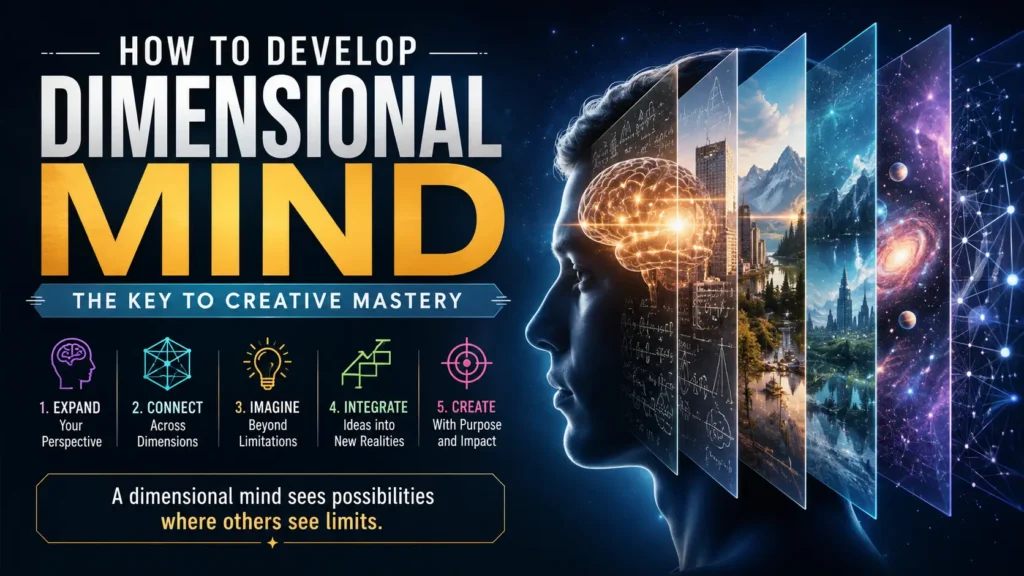
The good news is that a dimensional mind is not a rare gift. It is a state you can deliberately develop through the right approach and consistent practice.
What Is a Dimensional Mind?
A dimensional mind goes far beyond normal thinking. Instead of seeing things from just one angle, it perceives multiple layers, connections, and possibilities at once. This type of thinking allows you to solve problems more creatively, spot opportunities others miss, and create work that feels truly original.
It is the point where knowledge stops being rigid information and starts becoming fluid understanding. This is exactly what separates good performers from true masters in any field.
What It Really Means to Develop a Dimensional Mind
How to develop a dimensional mind starts with understanding what it actually is. It is not just thinking creatively or having good ideas. It is a higher state of thinking where you see problems, situations, and opportunities from multiple angles at the same time.
Instead of viewing the world in a flat, one-dimensional way, you begin to notice hidden layers, connections, and possibilities that others miss. This is the level where skill stops feeling like hard work and becomes almost instinctive.
The Foundation: Deep Immersion and Practice
You cannot develop a dimensional mind without first going through deep immersion. In the beginning, every action feels difficult and requires full conscious effort. You make mistakes, struggle with basics, and sometimes feel frustrated.
However, as you continue practicing consistently, something powerful happens. The skill slowly moves from your conscious mind into your subconscious. Your hands and mind begin to work together without you having to force every step. This deep mastery of the fundamentals frees up mental energy, allowing you to think at a much higher, more creative level.
Moving Beyond Textbook Thinking
How to develop a dimensional mind also requires breaking free from rigid, textbook-style thinking. During the early stages of learning, you must follow rules and structures. But true mastery comes when you learn to bend and reshape those rules based on your own experience and insight.
At this point, you stop being a follower of knowledge and start becoming a creator. You no longer see things only as they are taught — you begin to see them as they could be.
How to Develop Dimensional Mind Through Deep Immersion
How to develop dimensional mind starts with deep immersion in your chosen skill or field. In the beginning, everything feels difficult. You have to think about every single step, and mistakes happen frequently.
However, as you continue practicing consistently, something remarkable occurs. The skill gradually moves from your conscious effort into your subconscious. Your mind and body begin to work together naturally. This frees up mental energy, allowing you to think at a much higher and more creative level.
How to Develop Dimensional Mind by Moving Beyond Textbook Thinking
A crucial part of how to develop dimensional mind is learning to move beyond rigid textbook thinking. During the early apprenticeship phase, you must follow rules and structures carefully. But true mastery begins when you learn to bend and reshape those rules based on your own insights and experiences.
This shift allows you to stop being just a follower of knowledge and start becoming a true creator. You no longer see things only as they are taught — you begin to see them as they could be.
Adopting a Multi-Angled Perspective
How to develop dimensional mind also involves training yourself to see problems from multiple angles simultaneously. Instead of viewing a challenge as a single obstacle, you start noticing hidden layers, connections, and possibilities within it.
For example, Michelangelo didn’t just see a block of stone — he felt the figure already trapped inside it and worked to reveal it. Similarly, Einstein didn’t only memorize physics formulas; he used mental imagery to see the universe in new ways before proving his theories with logic.
How to Develop Dimensional Mind by Transitioning from Logic to Intuition
How to develop dimensional mind reaches its most powerful stage when you learn to fuse logic and intuition. After years of deep practice and study, the logical knowledge you have gained slowly sinks into your subconscious. At this point, you no longer need to calculate or overthink every move.
Your mind begins to make instinctive decisions based on deep understanding. This is not guesswork or magic — it is the natural result of logic becoming so familiar that it transforms into intuition. You start seeing patterns and solutions that others cannot.
The Fusion of Logic and Intuition
How to develop dimensional mind ultimately depends on this beautiful fusion. Logic gives you the strong foundation and rules, while intuition allows you to go beyond them.
When you combine both, you stop being limited by what is already known. You begin to see things not just as they are, but as they could be. This is the moment when true creativity is born. You move from following existing paths to creating new ones.
Never Stop Learning: The Mindset of a Dimensional Thinker
A key part of how to develop dimensional mind is maintaining a state of continuous learning. The biggest barrier most people face is believing they already know enough. True masters never consider themselves finished. They remain curious and keep challenging their own understanding.
This constant openness keeps their mind flexible and sharp. They are willing to fail, experiment, and explore new ideas. This lifelong commitment to growth is what allows their thinking to stay dimensional and creative, even after many years of mastery.
How to Develop Dimensional Mind Using Real-World Examples
How to develop dimensional mind becomes clearer when you study those who have already achieved it. Michelangelo is a perfect example. He didn’t just see a block of stone — he felt the figure trapped inside it and worked to set it free. This wasn’t simple carving; it was seeing beyond the obvious.
Similarly, Albert Einstein didn’t rely only on mathematical formulas. He used vivid mental imagery to explore ideas first, then proved them with logic. These masters show that how to develop dimensional mind involves combining deep knowledge with imagination and intuition.
How to Develop Dimensional Mind: From Knowledge to Visionary Thinking
How to develop dimensional mind is not about collecting more information. It is about reaching a point where knowledge becomes part of you. At this stage, you no longer think step-by-step. Your understanding flows naturally, allowing you to see solutions and opportunities that others miss.
You begin to see the world not just as it is, but as it could be. Problems stop being obstacles and start revealing hidden possibilities. This is the shift from being a skilled practitioner to becoming a true visionary in your field.
Maintaining Continuous Growth and Curiosity
How to develop dimensional mind requires a lifelong commitment to learning. The biggest obstacle most people face is believing they have learned enough. True masters never stop exploring. They remain curious and humble, always looking for new angles and deeper understanding.
This continuous growth keeps your mind flexible and creative. It prevents you from becoming rigid and ensures your thinking stays dimensional even as you gain more experience and expertise.
How to Develop Dimensional Mind: The Final Leap to Visionary Thinking
How to develop dimensional mind reaches its highest level when logic and intuition finally fuse together. After years of deep practice and immersion, the knowledge you have gained becomes part of your subconscious. You no longer need to calculate or overthink every move.
Your mind begins to work instinctively. You see patterns, connections, and possibilities that others cannot. This is the state where true creativity and mastery emerge — not through force, but through deep understanding.
How to Develop Dimensional Mind in Practice
How to develop dimensional mind is a gradual process. It requires patience, consistent practice, and the willingness to move beyond rigid rules. You start by mastering the fundamentals, then slowly train yourself to see from multiple angles. Over time, you learn to trust both your knowledge and your intuition.
The greatest masters — whether artists, scientists, or thinkers — all went through this same journey. They combined rigorous logic with imaginative insight. This fusion is what allowed them to create work that felt truly original and groundbreaking.
FAQ – People Also Ask
Q1: What does it mean to have a dimensional mind?
A dimensional mind is the ability to see things from multiple angles at once. Instead of thinking in a straight line, you notice hidden layers, connections, and possibilities that others miss.
Q2: How long does it take to develop a dimensional mind?
It usually takes years of deep, consistent practice. The shift happens gradually as knowledge moves from conscious effort into subconscious understanding.
Q3: Can anyone develop a dimensional mind?
Yes. It is not a rare talent. Anyone willing to commit to deep practice, continuous learning, and moving beyond textbook thinking can develop it.
Q4: How do I start developing a dimensional mind?
Start with deep immersion in your field. Master the basics first, then begin looking at problems from different perspectives. Combine logic with imagination and stay curious.
Q5: What is the difference between normal thinking and dimensional thinking?
Normal thinking is linear and rule-based. Dimensional thinking is multi-layered — you see beyond the obvious and combine knowledge with intuition to create new solutions.
Final Thoughts
How to develop dimensional mind is ultimately about moving from being a follower of knowledge to becoming a creator. It requires deep immersion, moving beyond rigid rules, adopting multiple perspectives, and fusing logic with intuition.
The journey is not quick, but it is incredibly rewarding. Those who commit to this process don’t just improve their skills — they transform the way they see and interact with the world.
Start today by immersing yourself fully in your craft, staying curious, and practicing the courage to see things differently. With time and consistent effort, you too can develop a dimensional mind and unlock your highest creative potential.