
The doctors looked him in the eye and said: “Your heart will explode.”
That is what Roger Bannister heard when he told the world he intended to run a mile in under four minutes. And yet, on May 6th, 1954, he did exactly that — finishing in 3 minutes and 59.4 seconds, very much alive, and forever rewriting what humanity believed was possible.
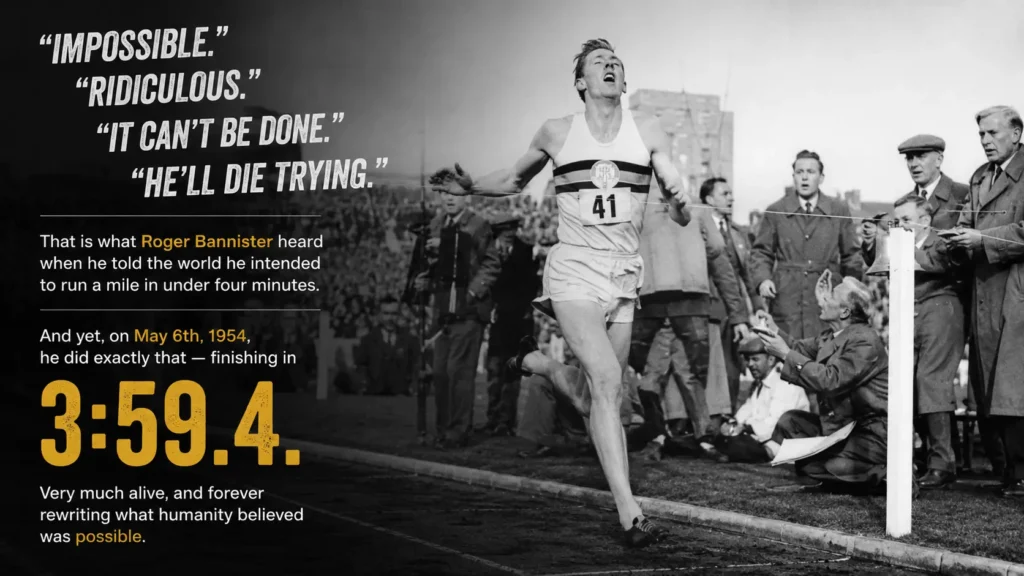
If you have been searching for the four minute mile Roger Bannister PDF, you are likely looking for more than just a running record. You are looking for the story behind the story — the mindset, the science, the psychological breakthrough, and the life lesson that has inspired coaches, leaders, athletes, and everyday people for over seven decades.
This article extracts every key insight from that foundational document and the powerful motivational account of Bannister’s achievement, and delivers it in one complete, deeply researched resource. Whether you are a student, a coach, an athlete, or someone who simply feels stuck at the edge of their own “four-minute mile,” what follows is for you.
Because here is the truth that both the historical record and Roger Bannister’s mindset before breaking the record confirm: the barrier was never physical. It was always psychological. And once one person proved that, everything changed.
Why the World Believed the Four-Minute Mile Was Physically Impossible
To truly understand the magnitude of what Roger Bannister achieved, you have to understand what the world believed before he did it.
For the better part of the early twentieth century, the four-minute mile was treated not as an athletic challenge but as a biological ceiling. Physiologists, doctors, and sports scientists widely argued that the human body had reached its limit. Running a mile in under four minutes, they said, would place such catastrophic strain on the cardiovascular system that the attempt itself could be fatal. This was not fringe thinking — it was the mainstream medical consensus of the era.
The world record at the time stood at 4 minutes and 1.4 seconds, set by Swedish runner Gunder Hägg in 1945. That record had remained unbroken for nine full years. Not because no one was trying — several elite runners in the early 1950s had dedicated themselves entirely to crashing through that barrier — but because, as the data shows, stopping yourself from going after what you want is not always a conscious choice. Sometimes it is a belief so deeply embedded in the culture around you that you absorb it without realizing.
The psychological weight of that collective belief was immense. One of Bannister’s chief rivals, Australian runner John Landy, had come agonizingly close to the barrier multiple times. Yet Landy himself reportedly said that someone may achieve the four-minute mile, but he did not believe he personally could. Unlike Bannister, Landy had internalized the impossibility. His repeated near-misses did not build momentum — they reinforced the ceiling.
This is precisely what makes the Roger Bannister four minute mile lesson so universally relevant. The limitation was not in the legs. It was in the mind. And the minds of even the world’s best runners had been shaped by what others had told them, by what had never been done before, and by what the so-called experts had declared to be the boundary of human capability.
The significance of Bannister’s event was not in the breaking of the record. The significance was that nobody had ever felt they were capable of achieving the four-minute mile — until he did it. And then, suddenly, people all over the world could.
Four Minute Mile Roger Bannister PDF: Who Was the Man Behind the Miracle?
Roger Gilbert Bannister was born on March 23, 1929, in Harrow, England. By his own account, he was not a natural-born runner. When he arrived at Oxford University in 1946, his great ambition was to row against Cambridge in the annual boat race on the Thames. He was told he was too light to make a first-rate oarsman. So he turned to running — and the rest, quite literally, became history.
From Medical Student to World Record Holder
What made Bannister’s achievement so extraordinary — and so instructive — was the context in which it happened. He was not a full-time professional athlete with unlimited resources, elite coaching staff, and purpose-built training facilities. He was a 25-year-old medical student at St. Mary’s Hospital Medical School in London, fitting his training into a schedule dominated by hospital rounds and academic study. His available track time was often limited to just 45 minutes per day.
But what his medical training restricted in hours, it more than compensated for in insight. Roger Bannister’s interval training method was not borrowed from a coach — it was engineered from first principles. By applying his knowledge of physiology and measuring his own oxygen consumption during runs, Bannister made a discovery that would reshape how athletes train: running consistent lap times required significantly less oxygen than running variable, erratic splits. Efficiency, not raw speed, was the key.
He developed a rigorous interval training protocol — running ten laps with two-minute rest intervals in between — and through this method, he steadily dropped his average quarter-mile split time from 63 seconds down to 59 seconds. That improvement, modest as it sounds, was precisely sufficient to break the elusive barrier.
The Day of the Race: Iffley Road, Oxford
The conditions on May 6th, 1954, were far from ideal. It had been windy and raining. A considerable crosswind was blowing across Oxford University’s Iffley Road track as the race was set to begin. Bannister, who had been obsessing about the wind since he left his London flat that morning, nearly considered pulling out.
At 6 p.m., the starting gun fired. In a carefully planned race, Bannister was aided by Chris Brasher, a former Cambridge runner who acted as a pacemaker for the first half-mile. Another runner then took over the lead, reaching the three-quarter-mile mark in 3 minutes and 0.4 seconds. Then, with approximately 350 yards remaining, Bannister took the lead.
His splits told the story of a perfectly executed race: 57.7 seconds, 60.7 seconds, 60.6 seconds, and a blazing final lap of 58.7 seconds. When the timekeeper’s clock stopped, it read 3 minutes and 59.4 seconds. The crowd erupted. Roger Bannister ran the mile in just under four minutes — and he did not die.
The Daily Telegraph had previously described the sub-four-minute mile as sport’s greatest goal — something as elusive and seemingly unattainable as Everest. On that cool May evening at a ramshackle university track, a medical student with 45 minutes of daily training time made it ordinary.
What Happened After Roger Bannister Broke the Four-Minute Mile
This is where the story stops being about athletics and starts being about the four minute mile psychology of achievement — and why it matters to every person who has ever held themselves back from something.
Within just 46 days of Bannister’s record, Australian rival John Landy — the same man who had declared the barrier beyond his reach — ran the mile in 3 minutes and 58 seconds, beating Bannister’s time by nearly two full seconds. The man who could not do it suddenly could, the moment someone else showed him it was possible.
But the cascade did not stop there.
Why Did More People Run a Four-Minute Mile After Bannister?
Within one year of Bannister’s achievement in 1954, 37 other runners had also broken the four-minute mile. The Source B script references 20 people within four years — but the fuller historical record confirms the ripple effect was even faster and more dramatic than that. Within a year, 37 runners had done what no human being had done in recorded history. Eleven years after Bannister’s run, a high school student named Jim Ryun ran the mile in under four minutes.
The question that demands an answer is: why did more people run a four-minute mile after Bannister?
The human body did not evolve. No new training technology was invented overnight. The track did not change. The air did not change. What changed was the mental model. The runners of the past had been held back by a mindset that said they could not surpass the four-minute mile. When that limit was broken, others saw that they could do something they had previously thought was impossible.
This is the precise mechanism described in both the CAFSTI document and the motivational account in Source B: how one person changed what others believed was possible. The barrier was a shared psychological construct — and Bannister dismantled it not just for himself, but for everyone who came after him.
Fixed Mindset vs Growth Mindset: The Four-Minute Mile
The contrast between Bannister and Landy (pre-1954) is one of the clearest real-world illustrations of the fixed mindset vs growth mindset four minute mile dynamic ever recorded. Landy operated from a fixed mindset — he interpreted repeated near-failures as evidence of a hard ceiling. Bannister operated from a growth mindset — he interpreted the same barrier as an engineering problem to be solved through science, preparation, and unwavering belief.
The key difference, as the source data makes clear, was not talent, physical gifts, or resources. What separated those who broke the barrier from those who did not was their belief system. Followers wait for leaders to show them what is possible. Leaders break the barriers of what is possible.
This is how belief affects athletic performance — and human performance in every domain.
Breaking Mental Barriers to Achieve Goals: What Bannister Really Taught Us
The moment Roger Bannister crossed that finish line, something shifted in the collective human consciousness. It was not just a running record that fell. It was a story the world had been telling itself — a story about limits, about what the body can bear, about what is and is not possible for a human being to achieve.
And that is precisely why the four minute mile self-limiting beliefs connection has become one of the most cited examples in psychology, leadership, business, and personal development literature. Because it is not really about running at all.
How Often Do We Hold Ourselves Back?
Source B asks a question that cuts straight to the heart of this lesson: How often do we not go after what we truly want for ourselves because of what we think is possible? How often do we not pursue our goals because of other people telling us what we can and cannot do — or because of our own internal narrative built from past failures?
The answer, for most people, is more often than they would like to admit.
Overcoming self-doubt to reach impossible goals is not a matter of ignoring reality. It is a matter of questioning whose reality you are accepting. Bannister questioned the doctors. He questioned the record books. He questioned the consensus. And he replaced the question “Is this possible?” with a more useful one: “How do I make this possible?”
This reframe — from impossibility to methodology — is the engine behind every meaningful human breakthrough. Once this barrier was broken, more and more people were able to do it because the ceiling of that limited thought in the collective consciousness ceased to exist.
The Belief System That Determines Success — Not Talent
One of the most striking insights drawn directly from the source material is this: belief system determines success, not talent. By all conventional indicators, Bannister should not have broken the four-minute mile. The expert consensus held that a combination of perfect weather, an elite training regime, an outstanding runner, and stellar track conditions were all required. Bannister had none of those things on May 6th, 1954 — it was cold, it was wet, it was windy, and he was a part-time athlete with 45 minutes of daily training.
What he had was an unshakeable internal model of what was achievable. He had done the science. He had done the work. And critically, he had refused to let the fear-based warnings of physiologists and doctors become his reality.
Impossible goals become possible not through magic, but through this precise sequence: one person refuses to accept the consensus ceiling, does the internal and external work required, and then crosses a line that resets what everyone else believes is achievable.
This is the four minute mile effect — and it shows up everywhere. In business, when one startup disrupts an industry that incumbents said could not be disrupted. In medicine, when one patient recovers from a condition others said was terminal. In communities, when one person builds something in a place where everyone said nothing could be built. Seeing the impossible done makes it possible. Proof enables belief, and belief unlocks ability.
Stopping Yourself From Going After What You Want
The most practical takeaway from Bannister’s story for everyday life is uncomfortable to sit with: the primary thing stopping yourself from going after what you want is almost never a lack of talent, resources, or opportunity. It is a belief — often absorbed unconsciously from the culture, the people around you, or your own past — that the thing you want is not available to you.
Source B frames it with elegant simplicity: “It all starts up here before it can happen out here.” Everything begins in the mind. The external achievement is always preceded by an internal decision to believe it is possible.
Roger Bannister — medical student, part-time runner, full-time believer — made that decision on a cold, windy evening in Oxford. And the world has never been the same since.
Roger Bannister’s Legacy: From Track Record to Human Blueprint
Roger Bannister did not stop at the four-minute mile. After retiring from competitive athletics, he became one of Europe’s leading neurologists, was made a knight — Sir Roger Bannister — and remained a deeply influential figure in both sports and medicine until his death on March 3, 2018, at the age of 88. His family announced that he died peacefully in Oxford, surrounded by those he loved.
British Prime Minister Theresa May led the tributes, calling him “a great British sporting icon whose achievements were an inspiration to us all.” The miracle mile — as it came to be known — had been run on a ramshackle university track before only a handful of spectators. Yet its reverberations have echoed across generations.
His story is cited in boardrooms, classrooms, therapy sessions, athletic training programs, and personal development frameworks worldwide. Because what he demonstrated on May 6th, 1954 was not simply that a human being could run fast. He demonstrated that the Roger Bannister story for motivation is, at its core, a story about the architecture of belief — and what becomes available to us the moment we stop accepting other people’s definitions of our limits.
As the source material states directly: your limits are decisions, not facts. That single sentence — the closing line of the motivational account in Source B — may be the most important thing anyone takes away from this entire story.
Frequently Asked Questions (People Also Ask)
1. What is the four minute mile Roger Bannister PDF about?
The four minute mile Roger Bannister PDF is an educational document that tells the story of Roger Bannister’s historic 1954 sub-four-minute mile run. It focuses not just on the athletic achievement but on the deeper lesson: that the barrier was psychological, not physical, and that once one person proved it was possible, others followed rapidly.
2. Why did doctors say the four-minute mile was impossible?
Doctors and physiologists of the era believed that running a mile in under four minutes would place such extreme strain on the human heart that it could be fatal. They warned Bannister that his heart would explode if he attempted it. This was the mainstream medical consensus — not fringe opinion — at the time.
3. What was Roger Bannister’s mindset before breaking the record?
Bannister operated with a growth mindset. Rather than accepting the consensus that the four-minute mile was impossible, he approached it as a scientific and engineering problem. He measured his oxygen consumption, developed an interval training protocol, and systematically built toward the goal while blocking out the fear-based narratives of those around him.
4. What happened after Roger Bannister broke the four-minute mile?
Within 46 days, John Landy beat Bannister’s time. Within one year, 37 other runners had also broken the four-minute mile. Within 11 years, even a high school student had done it. The psychological ceiling had been removed, and the achievement cascaded rapidly across the sport.
5. Why did more people run a four-minute mile after Bannister?
The human body did not change. What changed was the mental model. Once runners saw that the barrier was breakable, they stopped unconsciously limiting themselves. The collective belief shifted from “impossible” to “achievable,” and performance followed belief.
6. What is the four-minute mile effect?
The four-minute mile effect refers to the phenomenon where one person breaking through a perceived barrier — physical, psychological, or cultural — rapidly enables others to do the same. It has been observed in business, medicine, sports, and personal development. Seeing the impossible done makes it possible for others.
7. What were Roger Bannister’s self-limiting beliefs — and how did he overcome them?
Unlike many of his contemporaries, Bannister actively refused to internalize the limiting beliefs of his era. While others accepted the expert consensus that the four-minute mile was dangerous and impossible, Bannister questioned it through scientific inquiry and replaced doubt with a data-backed training methodology.
8. What is Roger Bannister’s interval training method?
Bannister developed an interval training protocol based on his medical knowledge of physiology. He ran ten laps with two-minute rest breaks in between, focusing on consistent quarter-mile splits rather than variable pacing. This reduced oxygen demand and gradually lowered his split times from 63 seconds to 59 seconds per quarter-mile.
9. How does the four-minute mile relate to self-limiting beliefs?
The four-minute mile is one of the most powerful real-world examples of how self-limiting beliefs — often absorbed from culture, experts, or past failures — can prevent people from achieving things they are physically and mentally capable of. Bannister’s achievement showed that the barrier existed primarily in the mind.
10. What is the fixed mindset vs growth mindset lesson from the four-minute mile?
John Landy (pre-1954) exemplified a fixed mindset — interpreting repeated near-failures as confirmation of a hard limit. Bannister exemplified a growth mindset — treating the barrier as a problem to be solved. The difference between them was not talent or physical ability. It was belief.
11. How does belief affect athletic performance?
The four-minute mile demonstrates that belief directly shapes performance outcomes. When runners believed the barrier was unbreakable, they unconsciously held back. Once Bannister proved it was breakable, others immediately began performing at higher levels — without any change in their physical training or conditioning.
12. What is the Roger Bannister lesson for everyday life?
The core lesson is that most human limits are psychological constructs, not physical facts. What you believe is possible for you shapes what you attempt, and what you attempt determines what you achieve. Bannister’s story is a direct challenge to accept other people’s definitions of your ceiling.
13. How did Roger Bannister’s belief system determine his success?
Bannister succeeded not because he was the most talented runner of his era, but because his belief system was different. He refused to accept the consensus, backed his belief with scientific methodology, and stayed focused on his goal rather than the warnings of others. His belief system — not his talent — was the differentiating factor.
14. What does “your limits are just decisions not facts” mean?
This phrase, drawn directly from the motivational account of Bannister’s achievement, means that the boundaries we place on ourselves are not objective realities — they are choices, often made unconsciously, based on what others have told us or what we have failed to do in the past. Limits can be revised the moment we decide to question them.
15. How did one person change what others believed was possible?
By completing the four-minute mile, Bannister did not just set a record — he reset the shared mental model of what was achievable. His single act of proof shifted the collective belief from “impossible” to “possible,” which is why 37 runners followed within 12 months. One act of proof cascades into many acts of achievement.
16. What are examples of impossible goals becoming possible?
The four-minute mile is the most cited example, but the pattern repeats throughout history. In medicine, once one patient recovers from a condition labeled terminal, others follow. In business, once one company disrupts an industry considered unassailable, others replicate the model. In every field, the first proof of possibility unlocks the door for many.
17. Why do people stop themselves from going after what they want?
Most people limit their goals based on what they have been told is possible — by society, by experts, by their own past failures, or by the absence of visible role models. The Bannister story demonstrates that these self-imposed ceilings are almost never based on objective reality. They are based on inherited belief systems that can be consciously challenged and changed.
18. How can I use the four-minute mile story to break my own mental barriers?
Start by identifying the specific belief that is acting as your ceiling. Ask whether it is based on fact or on what others have told you. Find evidence of people who have done what you want to do. Use that evidence to shift your internal model from “impossible” to “possible.” Then develop a methodology — just as Bannister did — and execute it with consistency.
19. What is the Roger Bannister story used for in motivation speeches?
The Roger Bannister story for motivation speeches is used to illustrate how psychological barriers are more powerful than physical ones — and how one act of courage and belief can inspire a cascade of achievement in others. It is a universal metaphor for breaking through the limits others place on us, and the limits we place on ourselves.
20. What is your impossible goal — and what is holding you back?
The final and most personal question the Bannister story poses is this: what is your four-minute mile? What is the goal you have been holding back from — because of what you have been told, because of past failures, or because no one around you has done it yet? Because what is your impossible goal mindset lesson from Bannister is simple: every impossible thing was impossible until one person decided it was not. That person could be you.
Conclusion: The Mile That Changed Everything
On a cold, windy evening in Oxford in 1954, a 25-year-old medical student ran 1,760 yards and changed the way the human race thinks about possibility. The four minute mile Roger Bannister PDF and the powerful motivational story built around it are not really about running. They are about the architecture of belief, the mechanics of breakthrough, and the simple but world-altering truth that your limits are decisions, not facts.
Bannister broke the record because he refused to accept a story that was not true. He did the science. He did the work. He blocked out the noise. And he crossed a line that had held humanity back not for years, but for generations.
The domino effect that followed — 37 runners within a year, a high school student within a decade — confirms what both the historical record and the psychological research have always suggested: breaking mental barriers to achieve goals begins with a single, private decision to question the ceiling above you.
So the only question that remains is the one Source B closes with, and it is directed at you: What is your impossible?
Because if history has taught us anything, it is this — once one person proves something is possible, the world is never the same again. You could be that person. The track is open. The clock is running.
Start.